

Tuesday, July 13, 2010
Re: Marilyn Monroe as a brand


Tuesday, July 6, 2010
Ethnic Dance Festival recap
It’s one of the many benefits of living in San Francisco that you get regaled with events like the Ethnic Dance Festival, four weeks of choreographic candy, with tens of troupes and individual artists performing at the Palace of Fine Arts

Last Saturday night we watched the last performance of the season, with a lineup that started off with a Christian ceremony grafted on pagan roots from Nayarit , Mexico
As it usually happens, some of the performances spoke more to me than others and I’m sure my own cultural background filtered everything to match my own paradigm, which is a pretentious way of saying – I liked some dances better than others, but that’s not a judgment on their intrinsic value. That said, three performances really stood out for me: an ensemble from Zimbabwe
In hindsight, it shouldn’t have surprised me that such very different performances would move me so deeply. I could even break them down according to Freud’s Id, Ego, Superego. The Zimbabwean dance carried with it a wildness and a purity of spirit that only cultures very close to the land still posses nowadays. From the toils of agricultural work as only means of subsistence to the abandon of celebration, the Zimbabwean dance reminded me of things our polished surroundings, sterile meeting rooms and buttoned-up social reunions have long ceased to offer: a genuine connection to one’s surroundings, expressed through movement. I’ll let you guess with which facet of my personality this performance resonated.
Bolivia Corazon de America was a feast for the eyes that catered to my inner child. Their dance, Magical Encounters in the Altiplano, told the story of a indiecita (indigenous woman) who runs into a gathering of surreal, humanized birds called suri. She’s fascinated by them – the dancers have huge feather headdresses that spin like ethereal flowers. Eventually, after hanging out with the birds for a while, she becomes a bird in her own right: a Cinderella story for the avian kingdom and a visual delight that transported me back to my days in junior high when I skipped school to read Quetzalcoatl in bed with a thermometer in my mouth, faking the flu.
 |
| Here you can see one of the enormous Bolivian headdresses |
I’ll leave you with his hopeful, sad and incredibly urgent-feeling lyrics:
“Did you hear about the rose that grew
From a crack in the concrete?
Provin’ nature’s laws wrong it
Learned how to walk without having feet
Funny it seems, but keeping its dreams
It learned how to breathe FRESH air
Long live the rose that grew from the concrete
When no one else even cared…”
Monday, June 28, 2010
On B(r)e(a)st Behavior
In a city like SF, where you can always count on the fog and never on the sun, on the rare occasions when the weather warms up for real, women and their faithful companions (…) sometimes are caught unprepared.
The below is my humble attempt at offering SF ladies some guidelines on how to react to such unusual circumstances. Disclaimer: the b(r)e(a)st practices were gleaned from observing actual San Franciscans in their own habitat, Discovery Channel-style.
So here’s what some owners might like to do with them on a warm weekend:
So here’s what some owners might like to do with them on a warm weekend:
 |
| The San Francisco War Memorial Opera |
- Squeeze them into tight, deep-cut dresses and take them out to watch Faust on Friday night at the San Francisco War Memorial Opera. If they get bored, use your binoculars to find other cousins of theirs exposed to high culture in the rows below. Unless, of course, you’re in box seats, in which case you’ve paid so much money, you’d rather faint than admit you’re bored. Suck it up.
- Let them aerate in flimsy dresses, taking advantage of an extremely warm Saturday afternoon. Maybe take them to grab a bite at Elite Café and then walk down Fillmore Street, spying on the state of other globular objects.
- If it’s too warm (I know, fat chance) cool them off with a wine spritzer in the shade of the Kabuki Cinema. While you’re there, take them to see SATC II, where they can gawk, together with you, at the girls’ outrageous and impossible ensembles, like high-heels in the middle of the desert, and shoulder pads adorned with life-sized poleaxes and other medieval weapons.
 |
| The Kabuki Sundance Cinema on Fillmore |
- In the evening, fit them into a strappy top and try to keep them in it, as bartenders at Asia SF will diligently attempt to apply non-fat whipped cream in their general area. An impressive array of bras in all colors, shapes and sizes hangs above the Asia SF downstairs bar, reminding all visitors that this is a place of liberte, egalite, fraternite and, occasionally, toplessness-ite. Alternately, if owners are brides to be and engaged in bachelorette party activities (of which there were at least five on Saturday night two weeks ago), said items could end up spending a significant amount of quality time with rear ends of tranny divas, as part of obligatory pre-nup lap-dance rituals. Onstage.
- If the warm weather persists (as a result of some cataclysmic climate changing-event), you have two options: go flower power or hop on yer bike. For the former, all you need is, yes, no bra and a tie-dye top that will accommodate fluid movement as you shake to the beats of the drum circle in Golden Gate Park. For the later, "support and cover" are the operative words - if not for yourself, at least for the sake of drivers coming from the opposite direction. You don’t want to have them on your conscience
 |
| SF Drum Circle on a colder day |
Et voila! SF ladies - am I missing anything?
Sunday, June 20, 2010
Hard Liquors of the Balkans
Rummaging through my bottom drawer at work, I found (among empty boxes of knee-high trouser socks, manhandled paper clips and empty Tupperware) a bottle of the famed "Ţuică"– the traditional Romanian liquor made out of plums.
I proceeded to trick one of my co-workers into trying it. “It smells sweet,” he said. “It’s made out of fruit,” I said, disingenuously. “My grandma makes it.” I filled the bottle’s cap and passed it to him. He took a swig and nearly died. A few minutes later, eyes watery and red-faced, he managed to croak, throat visibly throbbing “Wow. Grandma likes it strong.”
Before alienating any more of my American colleagues with shots of unexpectedly strong Romanian moonshine, here’s an outline of what Ţuică is, how it’s made and who are its other Balkan/East European cousins.
- Ţuică [tsui-ka] (
- Rakia [rakija] (Bulgarian: ракия) - Distilled alcohol made out of plums or mixed fruits throughout the Slavic countries (
- Tsipouro (Greek: Τσίπουρο) – Tzuica and Rakia are both related to
- Grappa (
Tuesday, June 8, 2010
Weapons of Art and Artifacts of War
A few evenings ago, in conversation with a friend, I was reminded of a piece of art I’d seen on display at SF’s very own DeYoung museum. The piece in question looks like a bronze-cast miniature cathedral, very accurate and beautifully detailed. Upon closer inspection, it comes almost as a shock to the unprepared eye that the roof of the cathedral is made out of bullets, and, slowly, it dawns on you, the viewer, that the whole of it is built out of shells, bullets, parts of rifles and pistols and so on.
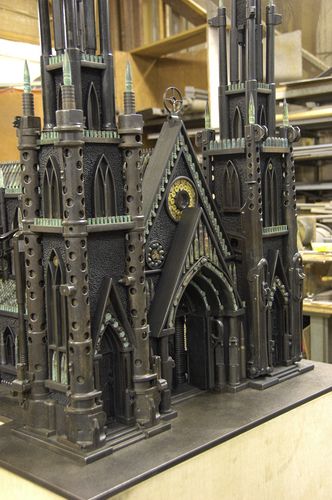
The cathedral in question is, in fact, a reliquary. You can check out the artist’s web site here to learn more about him and his work. In the middle of the nave rests a human spine (or human-looking, I haven’t actually investigated the origin of the bones; besides, I’m a fan of ambiguity), and the piece is titled “The Spine and Tooth of Santo Guerro.” Other of the artist’s pieces are reliquaries holding Santo Guerro’s (Spanish for “Saint War” or “Holy War”) “trigger finger,” teeth, ribs, etc.
So, in the context of his other works, I’m taking the cathedral to be a metaphor for all the nonsensical things people sacrifice and/or build in the name of war: lives, dreams, mausoleums, monuments.

Santo Guerro’s cathedral is a monument to death and destruction, created from the very instruments through which death and destruction are brought upon innocents. I wonder if, by choosing to build a cathedral rather than a laic monument, if Al Farrow wasn’t trying to say: Religion breeds war. But that’s just idle speculation…
In a strange twist of thought, talking about Santo Guerro’s cathedral brought about memories of a similar artifact that I had read about on Wikipedia – thanks to the daily featured pages. “La Escopetarra” – a guitar made out of a modified gun, invented by Colombian peace activist César López in 2003. Read Wiki’s whole article here.

Allegedly, the artist attempted to gift one of only five escopetarras to the Dalai Lama, but a member of the Dalai Lama's staff rejected his offer, citing the inappropriateness of giving a weapon as a gift.
Side by side, these two artifacts strike me as opposites stemming from the same source. La Escopetarra is a symbol of hope and transformation: a weapon married with a musical instrument ultimately sheds its bellicose purpose and becomes a vehicle for art or, at least, a symbol of art.
Santo Guerro’s cathedral, born out of empty bullet shells, bears a bleaker message: foolish people erect monuments to their destructive gods, perhaps in an attempt to make amends, but they build on a foundation of violence and destruction.
As an art lover, I take delight in both pieces, different as their message may be. They kindle in me a feeling of wonder at man’s ability for reinvention. You know, swords into ploughshares et al. And, in the end, what is life if not dichotomy? Santo Guerro and La Escopetarra are two sides of the same coin. We wage wars, we make peace, we build cathedrals, we make love, and then we wage some more war. History is cyclical.
Wednesday, June 2, 2010
A Camelia Shaped Hole in the World?
There is something to be said about the virtues of life off-line.
For a week in lovely La Saladita, Mexico, I experimented with the concept of being completely disconnected from the internet and phone and I immersed myself in the immediate reality. I have to say: for someone who works and practically lives online, there were almost no withdrawal symptoms.

Of course, it helped that I was in the great company of my better half, on a clean, quiet beach away from the hustle and bustle of a city (or even village), with a great long wave to continue my pursuit of standing on a surfboard and three books.
The result: books were read, conversations were had, naps were taken (ah, the sweet naps), food was eaten (lots of it) and Spanish was spoken. Perhaps the most surprising result of this trip was the discovery, upon return and due plug-in, that NOTHING HAD CHANGED. Not the bad things (Deepwater Horizon still spilling, Iran still enriching away), not the good things (our plants still alive, the apartment not burnt down, friends still recognize us), not the other things (memos still need to be sent, mail still needs to be sorted). Just Facebook is looking a little more dull.
“Of course!” you’ll say. “What did you think would happen in a week?”
But this feeling that the online and offline world goes on without you, whether you’ve voluntarily or involuntarily absconded from it, this feeling is eerie. In a way, it’s almost like a preview of how the world would unfold in my absence if the great eraser in the sky worked my stick figure out of the great scheme. There would be nothing left behind me. Dried apple cores and postcards.
I'm humbled. And tanned. :-)

Monday, May 17, 2010
Confessions of a Bikram lover
This is not a sappy love story. In fact, it’s a drama triggered by the conflict between pranayama breathing and soul-crushing capitalism.


Here’s how:
A little over a year ago, inspired by one of my DC friends who practiced Bikram religiously every Saturday morning, I started frequenting my local yoga studio (which shall remain unnamed for now) and partaking in the hour and a half sweaty, slightly stinky adventure that is Bikram. It helped that the studio was less than two blocks away from my apartment and that they had a very advantageous package for beginners (once they get you hooked, you’re theirs forever).
What is Bikram, you may ask. Bikram is a series of 26 yoga poses, each of which is performed twice in a single 90 minute class, in a room heated to 95-100 degrees Celsius. Its benefits, for me, have ranged from relieving and even obliterating pain from a torn meniscus in my knee and back pain caused by sedentary desk work, to building muscles in places I had no idea it was even possible. One immediate side effect is an enormous rush of serotonin and a feeling of being stretched and squeezed out, like a wet towel on a drying rack. Belive me, it’s a pleasant feeling. Another result I attribute to my weekly bikramming is that I managed NOT to sprain my ankle falling down the stairs of my apartment building the other day – something I’ve experienced before, from far gentler falls.
In the 14 months since I became a hot yoga aficionado, I’ve been taught the same class by about 20 people, which makes for intriguing comparisons. A teacher’s personality really comes through in this class by whether they stick exactly to the script or derail from it in idiosyncratic ways.
Among others, my various teachers have said things like: “Yeah, we have to stick to the damn script, so please hold your leg two inches beneath the knee, massaging the transversal colon” and “I saw an eagle flying in park the other day. He was soo… majestic,” and, “Don’t pay any attention to the loud alarms and the cries for help. This is Polk street, after all…” and, of course, the holiday-themed: “If you see me on the street with a tall guy, don’t tell him that basting the turkey is the hardest part.”
All in all – I loved it. The feeling of community with fellow sufferers who fell out of their poses before time was due, the exhilaration of pushing beyond my limits, especially on poses I thought I had perfected … It was beautiful.
But, alas, this love story was doomed: Two weeks ago, I was horrified to see in my inbox, courtesy of the local Groupon list, a coupon for 90% (NINETY PERCENT!!!!) off on 30 yoga classes at my studio. First impulse, of course, was to click on the BUY button – how naïve. The coupons must’ve sold out in the first thirty seconds. I won’t deny it - I felt betrayed and robbed. Classes are not exactly cheap and a give-away like this to random strangers was just unfair.

The long term effects of the Groupon maneuver were devastating: increasingly, over the following five classes, the towels and mats were pushed closer and closer together and we all had to jockey for space on poses that required “lifting our arms like Boeing 447,” on the narrow hallways and, eventually, in the locker rooms. On my last visit, the cherry on the cake: the toilet in the women’s bathroom overflowed, I had nowhere to put my shoes and we ran out of hand towels. This in addition to the indignities of rubbing against the sweaty people coming out of the previous class and having neighbors drip on my mat.
So that’s where I put my foot down and said: “Funky Door Yoga, between me, your loyal and loving companion, and a horde of undisciplined newbies who walk out of the room in the middle of class (!) and who came to you because you were cheap, you chose the newbies. This shall not pass!” (Yes, i just outed them...)
So I guess this is adieu for Funky Door and I. But I have a feeling this “capitalism” thing will take a toll on their established memberships. I could tell I wasn’t the only disgruntled of the “regulars”.
Monday, May 10, 2010
Things I discovered this weekend:
La Revolution Des Crabes
Lavender Sea Salt Shortbread at Blue Fog Markets
That rich people will outbid each other to pay $20,000 to put their names on a dam that will be demolished soon
That I love eating Serrano ham standing on the Embarcadero, shooting the breeze with friends

 That eight years is really not that long ...
Lavender Sea Salt Shortbread at Blue Fog Markets
That rich people will outbid each other to pay $20,000 to put their names on a dam that will be demolished soon
That one CAN get FREE OYSTERS if one is fearless, Israeli and a redhead
That there’s no limit to how much alcohol-imbibed lychee I can eat
That there are languages out there in which “women, fire and dangerous things” form their own category
 That eight years is really not that long ...
Tuesday, May 4, 2010
Gentlemen Prefer A Good Brand
This weekend I ended up watching two Marilyn Monroe films: Gentlemen Prefer Blondes and Some Like It Hot. I’d seen both of them before, a long time ago and I’d forgotten why people love Marilyn –after all, with the wealth of pretty blondes on the large and small screens, why would she stand out – a plump blonde in Technicolor?

But the truth is that she really does stand out: her studied sultriness is unmatched by any of her platinum blonde successors and her wardrobe hints at carnal knowledge without being overly revealing. She was a natural beauty but not shy about makeup and bling – this was after all the girl who sang Diamonds Are A Girl’s Best Friend in a bold magenta dress, bedecked in sparkling stones.
But everything about her – the grace with which she abandons herself into a man’s arms, the eyes that are half-closed most of the time except when she ogles (you guessed it) diamonds rings, the pouting lips, everything is true to the brand – a disciplined, well-manicured platinum blond brand that comes off effortlessly, a tribute to Marilyn’s real acting skills that come into play off the screen. If she comes off as a mediocre actress on screen, it’s an indication of the energy she siphoned off into sustaining her personal brand in real life.

It takes a real woman to take on Marilyn’s roles in real life and on the big screen: the blonde seductress, the material girl, the unrepentant bombshell who can talk even the shrillest penny-pinching bachelor into submission. She stayed true to her brand in silly roles like “Sugar” (I mean, really, Sugar?) of Some Like it Hot and the blond half of the cabaret couple in Gentlemen… , and very few people, indeed very few women (authors included) can probably appreciate the burden of being the Belle of all balls, the pressure, the scrutiny, the malignancy of the jealous gaze in tandem with being reduced to a sexual object for all men, of all ages and all occupations (easily verifiable through an inventory of the men she charms in her films: from decrepit old oligarchs to pre-pubescent shoe-shine boys).
But she stuck with it, unapologetically, until her untimely end. What a powerful brand!
Tuesday, April 27, 2010
Stars of Burma; Password - Mango
I think it would be safe to say that any respectable San Franciscan who has a simile of social life has at least heard of Burma Superstar and its sister, B Star Bar.

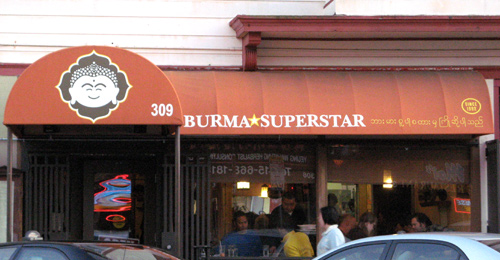
Both are restaurants on Clement Street, less than a block away from each other, under the same ownership and serving a similar menu of Burmese food. On Yelp, they both average four stars and get kudos for their fare, which is apparently a combination of Chinese, India and Thai cuisine over unique Burmese preparation techniques. Mango (in many shapes and preparations) seems to be the unifying element cutting across appetizers, salads and entrees, and thank God for that. I would’ve never thought of mango as a main ingredient in a pork dish, and it rocks!
Having visited both restaurants a total of 3 times in under 2 weeks, I feel compelled to commit to paper some notes on the cuisine, ambiance and service, before they fade away in the cloud of cheap take-out, salad bars and numerous Trader Joe’s dishes that make up most of my nourishment these days.
Burma Superstar is at its very best on weeknights. In fact, the difference is so great between weekdays and weeknights that they might as well call them Weekday Superstar and Weekend-Fussy-Diva-Past-Her-Prime. Tuesday evening we waited about 45 minutes for a table of six and on a Saturday evening about 2.5 hours again for a tabletop of six. On Tuesday we got seated at the house’s only 8-top, with a turn table in the middle, which made is exquisitely easy to share dishes and impressions. On Sunday, drunk, cold and unnerved, we were hurried through courses not only by the waiter but also by the notion that another hungry, drunk an unnerved 6-top was breathing down our neck outside, checking on the progress of our meal through the window. “Are they done yet?” “They just got their appetizers”. Or maybe that was us, waiting for the people before. (Before you judge: it's hard NOT to get drunk when you walk all day and wait to get seated until 9:00 PM... )
At any rate, in terms of ambiance, I am strongly biased in favor of the Weekday Superstar. The food, however, in both instances, was delicious and refreshing. From the mango salad (pickled mango! who knew?) and samusas to the basil chicken and lamb curry, even the vegetarian dish, which featured ginko nuts that were surprisingly pleasant – everything was adventure and delight. So maybe the mango chicken and the basil chicken were almost indistinguishable and the wood ear mushrooms tasted, well, a bit wooden, but really, that’s it.
As to B Star: take Weekday Superstar, add the possibility of making reservations, replace experienced staff with younger, slightly clumsier, but more accommodating folks, compress the menu a bit, eliminating the more hard-core Burmese stuff but adding salmon ochazuke (mmm….) and polish the décor to a more asian-fusion look – and there you go. I can strongly recommend the fried trout on a bed of rice and (!) mango, the pan roasted sea bass and the aforementioned ochazuke which is a so-called “comfort food” dish, which in the Japanese mindset includes green tea, salmon and poached eggs.
Let me know what you think of either restaurant next time you try them. I LOVE to compare notes.
Thursday, April 22, 2010
… And a Merry Vampire Weekend to You All!

On a cold and gloomy week day, my better half and I drove to Oakland’s Fox Theater to watch Vampire Weekend give the last performance of their US tour, hoping (for our sake) that they would go out with a *bang*. The Fox Theater on its own deserves another review, which I will hopefully manage to write after completing the required amount of billable hours some other day …
As to VW: We were not disappointed. Even seated (seated!) at the mezzanine, VW’s infectious energy caught up with us and, by the last song, they had us bouncing off our chairs. If you’re not familiar with Vampire Weekend, I strongly recommend listening to eponymous debut album before diving into their latest Contra. Vampire Weekend, the album, has a familiar storyline for anyone who lived on the East Coast, specifically in Boston and Cape Cod, anyone who went to college, popped their collar, took English lit, listened to Bob Marley, fancied themselves a philosopher, waited tables in Wellfleet and spent innumerable hours in Harvard Square/Foggy Bottom sipping coffee and mingling with Ivy-league folks. But really, I’m doing VW a disservice by limiting them to such a select crowd – their appeal is universal.
On their first album, Mansard Roof opens with lyrics that speak volumes to anyone who’s ever spent a summer in a hot city anywhere in the world, yearning for relief from dust and noise: “I see a salty message written in the eaves/ The ground beneath my feet/The hot garbage and concrete/And now the tops of buildings, I can see them too…” And reversely, the song Walcott, even though it takes shots at a summer hotspots for Bostonites (“Hyannis is ghetto”), it applies to any place where pale sweaty people serve tanned, rested people tall glasses of Arnold Palmer (ah, the irresistible pull of accelerated seasonal income): “Walcott, Don't you know/That it's insane?/Don't you want to/Get out of Cape Cod?/Out of Cape Cod tonight?”
On stage, their footwork is as playful as their strings, and they’re leggy and bouncy in the fashion of ‘80s synth-pop stars, minus the affected stances. They take obvious enjoyment in their music and use the surprise factor in their favor, keeping their songs curt like their lyrics, with abrupt endings that leave you wanting more. Their brand of music has been dubbed by others (more knowledgeable than me) as “preppy punky afro-pop,” but VW themselves profess to be "Upper West Side Soweto" (whatever that is).
Anyway, I love these preppy leggy punks and I think you would like them too. If you don’t already.
PS: Thank you, Tom, for introducing us to them.
Tuesday, April 6, 2010
Breaking News: Soul Searching Yields Results
The good news first: While thinking about all the things this blog could become, and all the things I don't have time to do, I had a "Click" moment (repeatedly, of course, as it takes more than one click to make me tick) -- I'm dying to tell the world about the fantastic books that I've read and films I've watched these past few years. And so I shall.
The bad news now: Well. *clearing throat* A moment of honesty is required here. I started this blog as a shameless tool of professional self-promotion. So that bad news is actually more good news. Self-promotion - finito! I am now writing for the sheer love of reading :-)
Planning to go public, too, as soon as I have a few reviews under my belt.
Till then, check out this piece from the NYT on what they call "Neuro Lit Crit". What they say is that brain mapping may provide answers to our penchant for one kind or another of literature, and our abilities to empathize with others.
This paragraph, however, delivers good news on a mightily depressing tone:
“At a time when university literature departments are confronting painful budget cuts, a moribund job market and pointed scrutiny about the purpose and value of an education in the humanities, the cross-pollination of English and psychology is providing a revitalizing lift”
Yppie-ya-yey?
Wednesday, January 13, 2010
Once a Journalist, Always a Journalist
So it's time for a little confession:
Deadline USA, All the President's Men, The Paper, His Girl Friday, Up, Close and Personal, (State of Play definitely falls in this category but came too late) - these were dangerous movies for an impressionable young mind such as mine. For a while in my past (college years and grad school) I sincerely believed that I wanted to be a journalist.
I majored in Journalism/Mass Media, then got an MA in Media and Public Affairs, working for school papers, contributing for my hometown sheet, bylining for a national financial journal, interning with experienced journalists.
But then, after almost 2 years in the States, when it became obvious that there was no chance for me to get a job in journalism (papers were already struggling with dwindling readerships in 2006, and my English writing skills were still not up to par) - I gave up, turned in, tuned out and took an internship with a public relatiosn firm. One thing led to another and, four years later, here I am, working for a public relations giant.
Looking back, I think I made the right decision. It's a sad thing when you realize that crushing your own dreams with the fist of practicality was "the right thing to do".
This is the piece that got me thinking about it: Lou and Me, by Don Terry, formerly of the Chicago Defender, the Chicago Tribune, the St. Paul Pioneer Press, the St. Paul Dispatch, and The New York Times, where he was part of the team that won the Pulitzer Prize in 2001 for the series "How Race is Lived in America."
My heart is with you, Don.
Tuesday, December 15, 2009
Liber Novus at Last!
So Jung's Red Book finally came out this year, a private diary-like record he kept for 16 years and that was mostly unknown to the world outside of this family. The most fantastic thing about it is not the massive price tag ( $195 on the publisher's web site) but the fantastic drawings inside, drawings that reveal Jung's most intimate mental environment that he descended into in an attempt to explore and expose the unconscious.
My take on it, and granted, I'm biased because I really appreciate Jung not only for his value as counter-balance to Freud's dark world of impulse, but as a direct and indirect source of inspiration to so many authors, painters and film-makers that have delighted me over the years: This is going to be BIG. The Times already covered the book twice in less than 30 days, with extensive articles, if that's a sign of anything. But I predict that over the coming years, many will be inspired and intrigued by this book in ways not unlike the collectors' fascination with new canvasses from old masters.
On the commercial side of things - reasons why the Red Book will not make the list of best-sellers this year:
- way too expensive
- not widely accessible in bookstores
- unlikely to make a good movie, even with top shelf special effects a la Avatar
- and, finally, who is this Jung guy anyway?
Subscribe to:
Posts (Atom)


 Posts
Posts

